Paved sites send a lot of water to a few low points, and the people who use them notice fast. Most fixes on small commercial and HOA properties use the same parts as a house, sized for more water and heavier loads.
Paved commercial sites shed nearly all of their rain, and they shed it toward a handful of low points: an entrance, a loading dock, a corner of the lot, a landscaped island. When those points cannot keep up, customers wade through puddles, docks flood and pavement breaks up. Rein Irving Drainage Company handles site-level drainage for small commercial properties and HOA common areas around Irving, using the same parts as residential work, sized for more water and heavier loads.
What is in scope
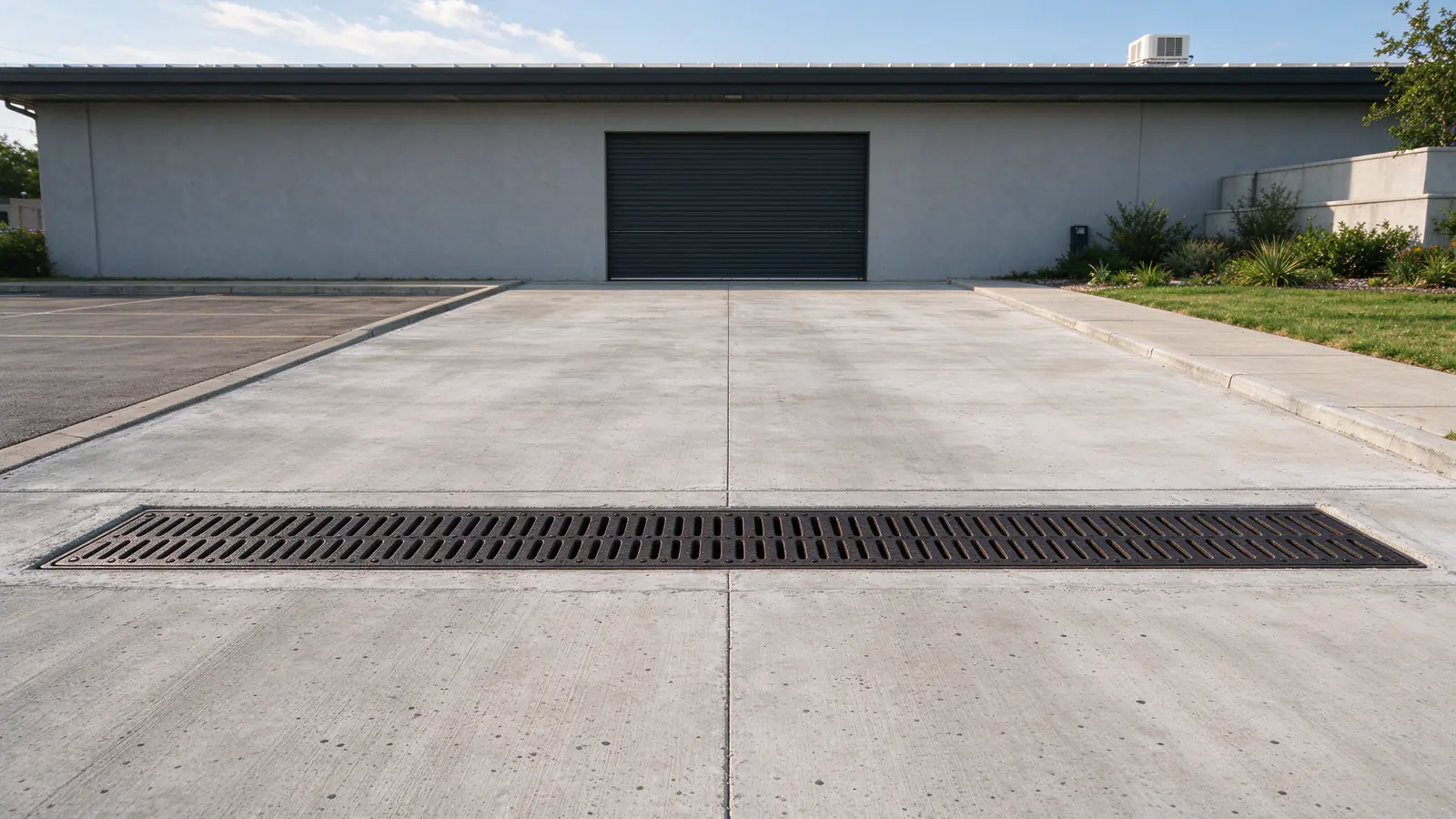
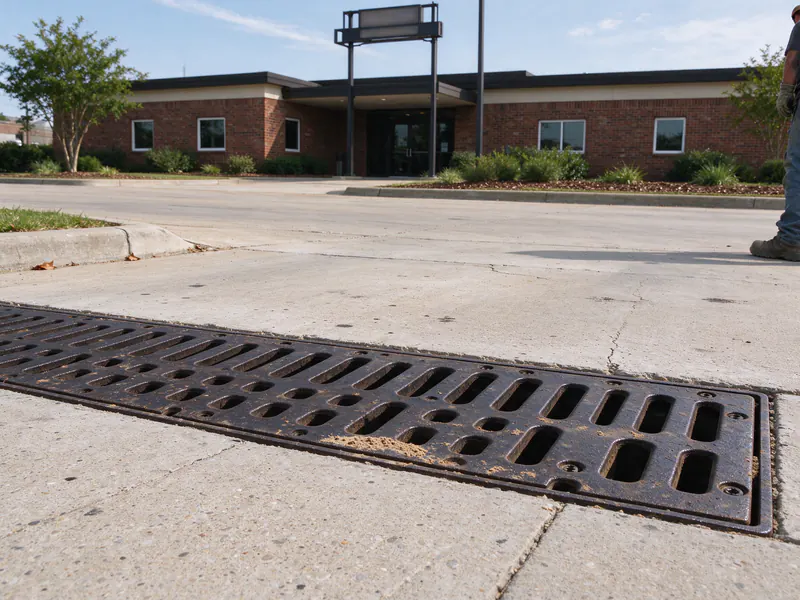
Trench drains at building entrances, drive-through lanes, ramps and loading docks.
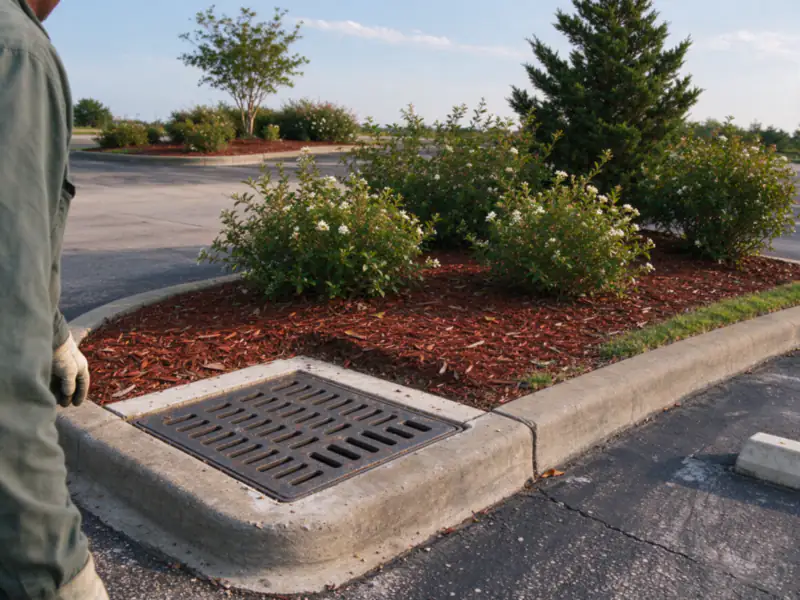
Inlets and catch basins in parking lot low points and landscaped islands.
Swales and regrading in HOA common areas, greenbelts and along fences between lots.
Roof drain lines from downspouts and scuppers to an approved outlet.
Repair of clogged, crushed or root-filled lines, settled inlets and broken grates.
What is not
Engineered detention ponds, public storm sewer construction, floodplain reclamation and work that requires a site’s drainage design to be recalculated belong to a civil engineer and a utility contractor. Where a project needs those, we say so at the start. Smaller work on those sites, such as repairing an inlet or adding a trench drain at a door, can still fit inside an engineer’s plan.
Paving, load and capacity
A parking lot behaves like a very large roof. Each inch of rain on 1,000 square feet of pavement is about 620 gallons, and NOAA’s Atlas 14 puts Irving’s 2-year storm at 1.77 inches in one hour and its 10-year storm at 2.52 inches. A low corner collecting from a large lot sees that hour all at once.
Commercial drainage tends to involve more approvals than residential work. Connections to a public storm system, work in the right-of-way and changes to a site’s drainage pattern usually need city review, and often a civil engineer’s plan. Several of the cities near Irving set specific rules: Grand Prairie requires an earthwork permit when a grade or drainage pattern is altered, and Dallas reviews earthwork in a floodplain. For Irving properties we confirm the requirement per address before work starts. The permits guide collects the rules we have found.
Irving’s own drainage work
The City of Irving invests in its storm system directly. It built a subdrain on Wingren Drive in Las Colinas to deal with groundwater, built about 900 linear feet of concrete flume behind Denali Drive, and is carrying out a channel project on West Irving Creek funded in part by a drainage utility rate increase and a state water board grant. Sites near those projects, or near any creek, are worth checking against the city’s floodplain maps before planning work; see floodplain or drainage problem.
HOA common areas
HOA greenbelts and common strips often carry water from many lots at once. Problems there show up as a soggy strip behind a row of houses, erosion along a fence line or a swale that has filled in over the years. The fixes are the same as for a yard: regrading and swales, catch basins and short French drain sections where water moves through the soil. Recorded drainage easements and the HOA’s own approval process shape what can be built and when.
Repairs on existing systems
Many commercial calls are repairs. A parking lot inlet that holds water is usually blocked or has a crushed outlet pipe; a trench drain that overflows usually has a blocked sediment box or line. Cleaning, flushing and a camera inspection come before any concrete is cut. See drainage repair.
How the work runs
Walk the site with the property manager, ideally during or after rain.
Confirm approvals, including whether an engineer’s plan or city review is required.
811 locate and a private utility locate where the site has private lines.
Phase the work so entrances, parking and docks stay usable.
Build and test each part before paving or sod is restored.
Document where every line runs and how deep, for future maintenance.
Rein Irving Drainage Company plans and manages each job; installation is carried out by licensed and insured drainage contractors we work with.
Cost
Commercial work is priced per site. The main drivers are concrete and asphalt cutting and replacement, grate ratings, pipe size and length, approvals and engineering, traffic control and phasing, and restoration. As national budgeting ranges for residential-scale parts, channel drains run about $700 to $2,500 and catch basins about $500 to $1,500 each; commercial versions with heavier grates and larger pipe cost more. The channel drain cost guide explains the drivers.
What this work looks like
Heavy cast iron trench drain grate across a commercial parking lot entranceCurb inlet grate in a landscaped island of a small parking lot
Questions people ask
What kinds of commercial drainage work do you handle?
Site-level work on small commercial and HOA properties: trench drains at entrances and docks, inlets in landscaped islands, swales and regrading in common areas, roof drain lines, and repair of existing lines. Engineered detention and public storm systems are outside the scope.
Does commercial drainage work need an engineer?
Often. Work that changes how a site drains, connects to a public storm system or sits in a floodplain usually needs a civil engineer's plan and city review. Smaller repairs and like-for-like replacements often do not, and the city confirms which applies.
Can work be scheduled around business hours?
Phasing is planned with the property manager so entrances, parking and docks stay usable. When work can be scheduled is set per job, based on the site and the contractor's availability.
Why does our parking lot flood at the same corner?
Usually because the inlet at that corner is clogged, the pipe from it is blocked or crushed, or paving has settled and changed the slope. Cleaning and a camera inspection come before any concrete is cut.
Can HOA common areas use the same fixes as a yard?
Generally yes: swales, catch basins, French drain sections and regrading. The difference is the scale and the approvals, since common areas often carry drainage from many lots and may sit in recorded drainage easements.
Water problems on a commercial or HOA property?
Send photos of where water collects and the property address.