
Water that stands for days
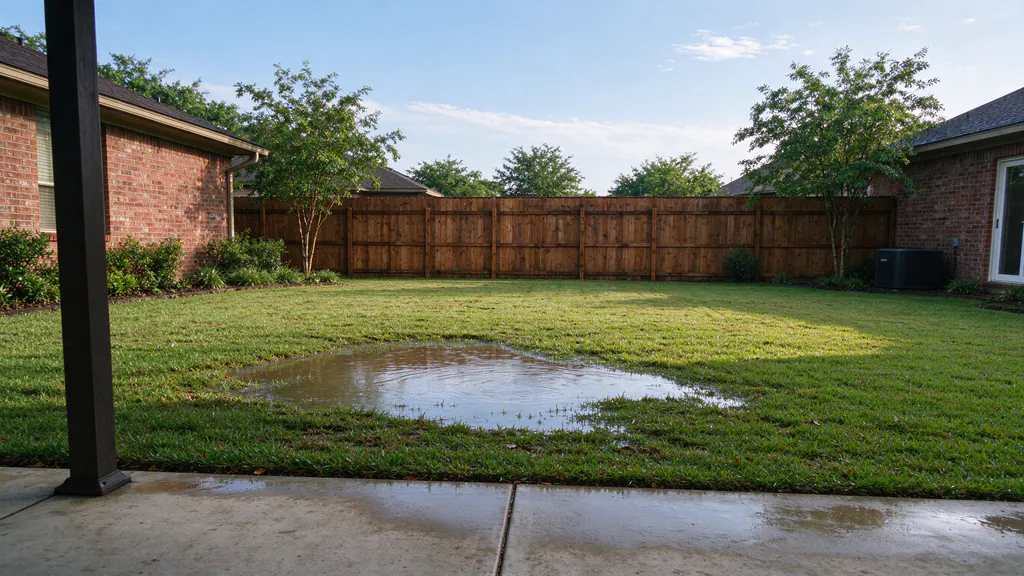
A low spot that holds water two or three days after rain usually means the ground there has no fall to an outlet, or clay a few inches down is holding it.
Every yard drains differently. Clay in Las Colinas, sand over clay in central Irving, a street that sends water up the driveway. We start with where the water comes from and where it is allowed to go, then build the fix that moves it.
Get an estimate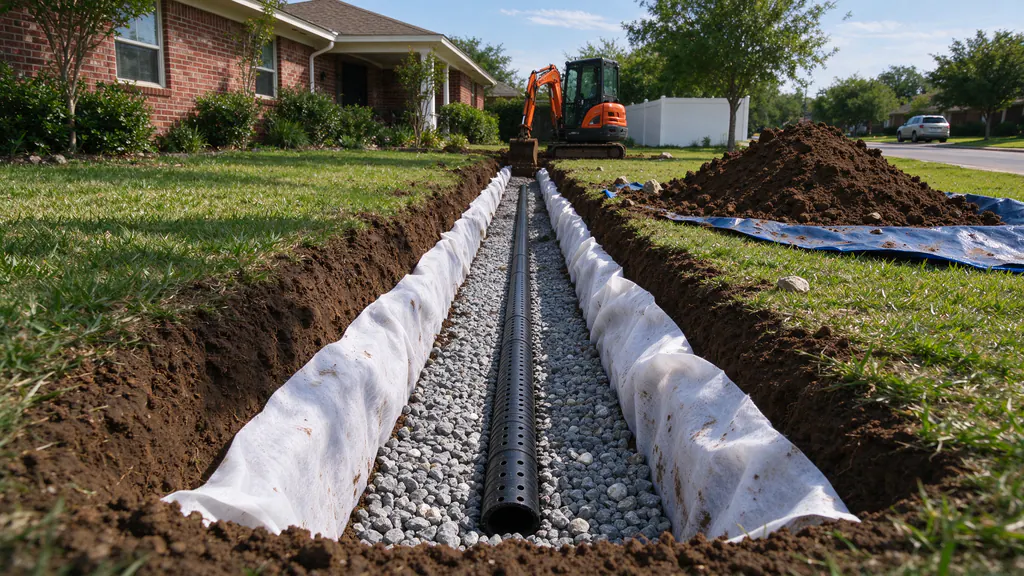
Outlet firstCurb core, swale, pop-up or pump, chosen before any digging.
1.77 in in an hourIrving's 2-year storm (NOAA Atlas 14). Drains are sized for bursts, not drizzle.
Ranges publishedTypical Dallas-area French drains run about $25 to $55 a foot installed.
811 before diggingEvery trench starts with a utility locate request.
Lawn put backSod re-laid and sprinkler lines repaired along the trench.
Most calls start with one of four things. None of them is an emergency on its own, but each gets worse with every heavy rain until the water has somewhere better to go.
A low spot that holds water two or three days after rain usually means the ground there has no fall to an outlet, or clay a few inches down is holding it.
Downspouts dumping at the wall and soil sloping toward the house send water to the one place it does the most harm on expansive clay.
Street runoff, a reverse-sloped apron or a garage set low can all push water inside. Some of it is a city-side condition we cannot change.
Grading, downspouts and ponding show up on Texas inspection reports all the time.
A drainage item on an inspection report is a scope question, not a verdict. The useful step before closing is to learn whether the fix is surface work (regrading, downspout lines, a catch basin) or something that needs a trench and an outlet, because those differ in cost by thousands. Ask where water stands after rain, whether the lot drains to the street or an alley, and whether any drain lines already exist. Then get a written scope you can use in the negotiation. Read the buyer's guide
Eleven kinds of drainage work, each explained the way we would explain it on your lawn: what causes the problem, what the fix involves, and what changes the scope.
A French drain collects water that is moving through the soil and carries it to an outlet. It is the right tool for saturated ground, seepage along a slope and water that soaks a side yard, and the wrong tool for a puddle on top of hard clay.
A trench cut to a set fall, filter fabric, washed stone and perforated pipe, a cleanout where the run turns, and a real outlet at the low end.
Trench length and depth, how far the outlet is, roots and old fills, and how much lawn and sprinkler line has to be put back.
Before any French drain is priced, we confirm two things: that the water really is moving through the soil, and that there is an outlet lower than the trench. Without both, the drain fills and holds water instead of moving it. Where a run follows a fence or a side yard, an interceptor line (often called a curtain drain) can catch water coming from a neighbor before it reaches the house.
Depth follows the outlet, not a rule of thumb. Most yard runs sit 12 to 24 inches down with a steady fall, and we add a cleanout wherever the line turns so it can be flushed later.
Clay is why so many French drains here stop working. Las Colinas sits on Ferris clay that is about half clay particles and barely lets water in, so a drain there mostly intercepts water moving along the surface of the clay. Fine clay also clogs the wrong fabric. In central Irving, where sand sits over clay a foot down, a shallow drain along the clay line works well. Nonwoven fabric around the stone, not a fabric sock on the pipe, keeps clay fines out longer. How clay changes a French drain
Some yards need more than one fix. Roof water, a low corner and a side yard that never dries often share one outlet, and solving them one at a time can mean digging the same lawn twice.
When water arrives from more than one direction, when the only outlet is at the far end of the lot, or when a past single fix moved the puddle somewhere else.
Smooth-wall solid pipe for conveyance, cleanouts at the turns, and joints that do not rely on tape. Thin corrugated pipe crushes and silts up in clay.
The plan is drawn first, priced as phases if you want, and built so later phases tie in without reopening finished work.
We draw the plan on a site sketch, mark the outlet and each inlet, and show you which parts solve which problem before anything is priced.
A whole-yard plan also records where every line runs and how deep, so a future patio, pool or fence does not cut through it by mistake.
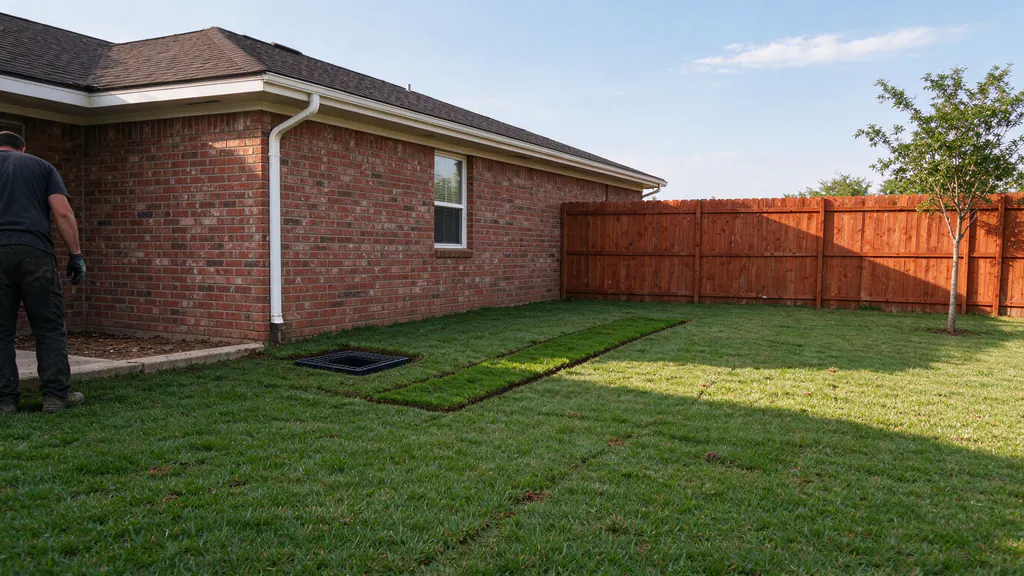
A catch basin is a grated box set at the lowest point of a lawn or patio. Surface water drops in and leaves through solid pipe, which makes basins the direct answer for a puddle that forms in the same spot after every storm.
Low spots, downspout landing zones, the corner where two slopes meet, and patios with nowhere to shed water.
Enough fall from the grate to the outlet, a grate sized for the area that drains to it, and a basin someone can reach to clean.
In flat Irving yards the hard part is fall: a basin set too deep needs a deep, long trench to reach an outlet, and one set too shallow will not catch the water. We set the grate a little below the finished lawn, regrade the area around it so water actually reaches it, and send it through solid pipe to the same outlet as any downspout lines.
A grate in turf can be plastic; one in a driveway or patio needs a traffic-rated grate. Pairing a basin with buried downspout lines is common, since both carry surface water and can share one solid pipe.
If the low spot sits against a fence or a walk, the basin goes at the lowest reachable point and the ground around it is shaped to feed it.
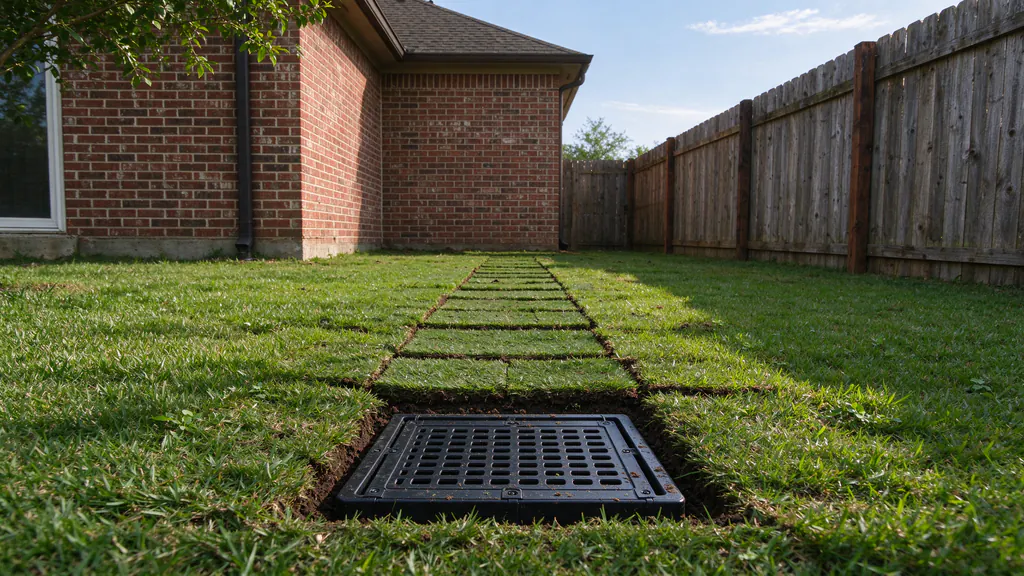
Basins collect leaves, mulch and grass clippings by design, which is what keeps that debris out of the pipe. Lifting the grate and scooping the sump after leaf drop and after the first big spring storm keeps most systems flowing. A basin that still holds water a day after rain usually has a blocked or flat line downstream, not a dirty grate. Grates at downspout landing zones tend to fill first, because roof grit and shingle granules settle in the sump. Catch basin cleaning
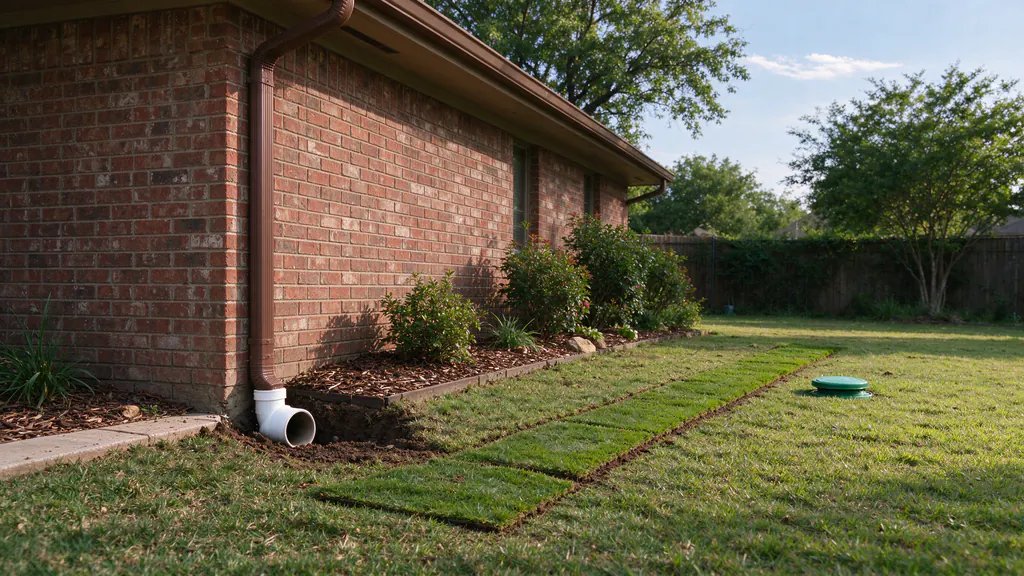
A roof sheds a lot of water at a few corners. Burying those downspouts in solid pipe carries the water past the foundation and the flower beds to a pop-up emitter, a swale or the curb, instead of soaking the soil beside the slab.
A 1,000 sq ft roof section in Irving's 1.77 in, one-hour storm sheds about this much water to its downspouts. Small 3 in lines can back up and spill at the corner.
An adapter at each downspout, smooth solid pipe laid with a steady fall, a cleanout near the house, and an outlet such as a pop-up emitter, a swale or a curb core where the city allows it.
The number of downspouts, how far the outlet is, whether the line crosses a walk or driveway, and roof sections large enough to need 4 in pipe or more.
Pop-up emitters suit lawns that slope away from the house. On a flat lot, the line usually needs to reach a swale, the curb or a lower corner, or the water simply comes back up near the house.
Lines are tested with a hose before backfill so you can see the water leave at the outlet, not just disappear underground.
Roof water should travel in smooth solid pipe until it reaches its outlet. Perforated pipe leaks that water back into the soil next to the house, which is exactly where you are trying to keep it out. Tying downspouts into a French drain also floods the drain's stone in a burst storm. Keep roof water and ground water in separate lines unless a designer has sized one pipe for both. A cleanout near each downspout lets the line be flushed of roof grit. Perforated or solid?
Every inch of rain on 1,000 square feet of roof is about 620 gallons. NOAA's Atlas 14 puts Irving's 2-year storm at 1.77 inches in one hour and 3.95 inches in a day, and the 100-year day at 9.34 inches. Those bursts, not annual totals, decide pipe size and where an overflow goes. A two-story house with four downspouts can send several thousand gallons to a single corner in one storm, which is why one undersized line backs up first. Roof runoff in a storm
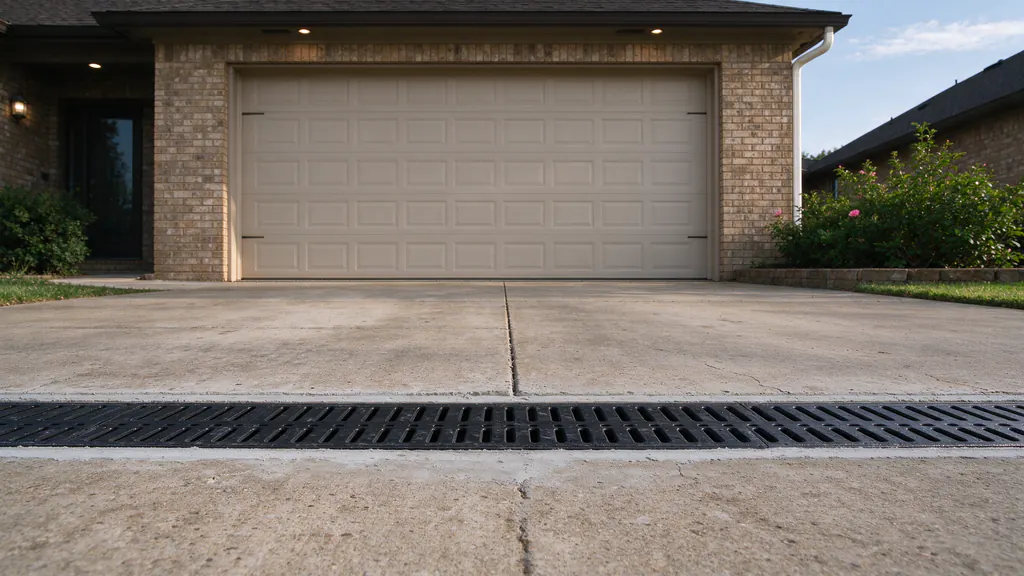
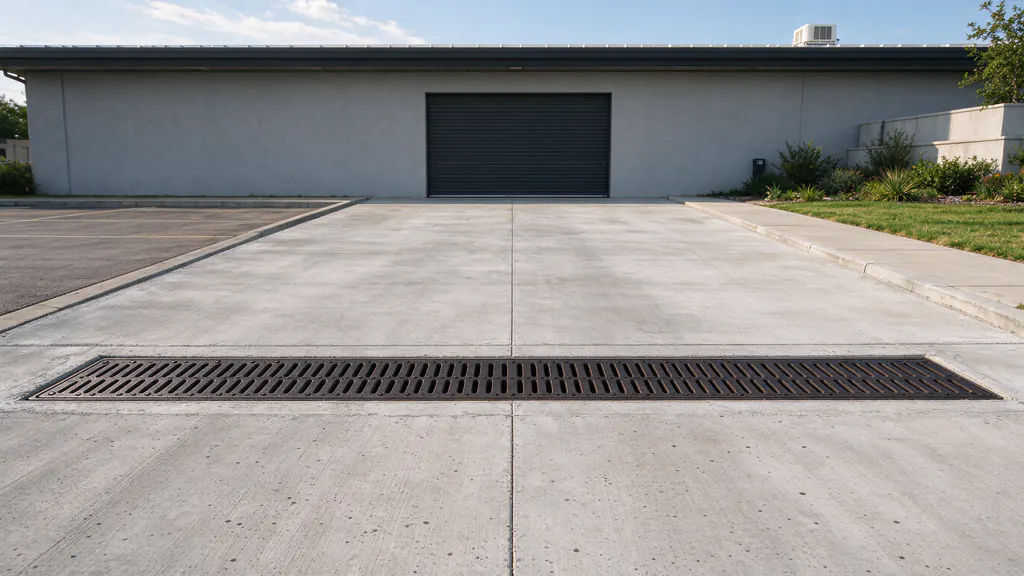
A channel drain is a long, narrow grated trough set into concrete. It catches sheet flow across a driveway, garage apron, patio or pool deck, which a round catch basin cannot do.
Saw-cut the concrete, set the channel to grade on a concrete bed, pipe it to an outlet and pour new concrete on both sides flush with the grate.
Length, load rating (a driveway needs more than a patio), outlet distance and how much concrete has to be replaced.
A channel drain only catches water that reaches it, so it goes where the slope already sends water: at the low edge of a patio, just outside a garage door, or at the bottom of a driveway that falls toward the house.
The grate is chosen for what drives over it, and the outlet pipe is sized for the paved area that drains to it, since concrete sheds nearly all the rain that falls on it.
We match the new concrete to the old as closely as practical, and the saw cuts are kept straight so the repair reads as deliberate.
If water runs from the street up a driveway, part of the cause can be the curb or the street itself, which belongs to the city. A channel drain across the apron catches what reaches your property and sends it to an outlet. It cannot raise a curb or fix a street. Irving rebuilt one driveway approach in 2022 to keep stormwater in the right-of-way, which shows the city side matters. A raised lip at the garage threshold or regrading the apron can help where the driveway itself slopes toward the house. Street water and driveways
A national budgeting range for a driveway or patio channel drain is about $700 to $2,500. Length, the grate's load rating, the concrete that has to be cut and replaced, and outlet distance decide where a job lands. A patio drain with a short run to a lawn outlet sits at the low end. A driveway-rated channel across the full width of a garage, with new concrete on both sides and a long pipe to the curb, sits at the high end. Channel drain cost in Irving
Sometimes the cheapest drain is the ground itself. Regrading reshapes the soil so water runs away from the house, and a swale is a shallow, grassed channel that carries it along a property line to the front or an alley.
Good grading starts with numbers: about six inches of fall in the first ten feet away from the foundation is the common residential target, and Grand Prairie's design manual sets 1 percent as the minimum for earthen grades. We shoot elevations, stake the finished grades, move soil with the right machine for the yard, and re-sod.
Six inches over ten feet next to the house (5 percent) moves water off quickly; across open lawn, 1 to 2 percent is usually enough if the path continues to an outlet. University Park caps side-yard grades at 5 percent. Paved areas can drain at less: Grand Prairie's manual allows 0.5 percent on paving. Flatter than that, water lingers in every footprint and tire track. Fall is checked with a laser or string line, not by eye. The slope has to continue all the way to the outlet. Slope for yard drainage
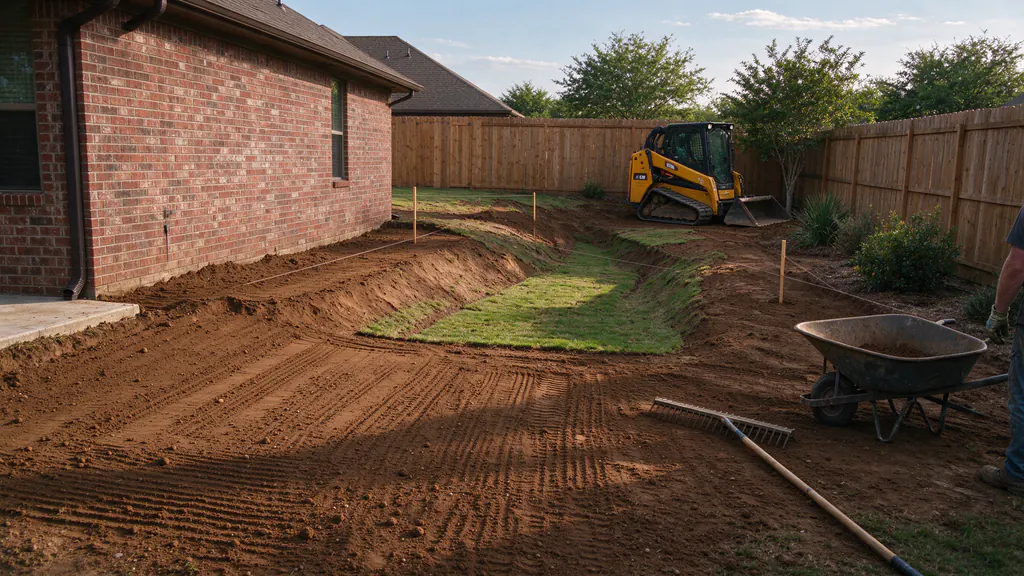
Regrading prices vary too much to quote a single range. Yard size, how much soil has to come in or go out, access for a machine, re-sodding, and whether a permit applies set the number. In Grand Prairie, changing a lot's grade or drainage pattern needs an earthwork permit, $50 for a lot under half an acre. Dallas exempts single-family lots under two acres from its grading permit. Irving's requirement is confirmed per address. Soil haul-off is often the largest single line. Regrading cost in Irving
Regrading also fixes a common cause of water at the slab: years of mulch, flower-bed edging and sod build-up that leave soil higher against the house than a few feet out. Pulling that back and re-establishing the slope is often the first step before any drain.
Each job ends with the finished grades checked against the stakes, the soil firmed so it does not settle back into a dip, and the area re-sodded or seeded.
Where a yard needs a swale along the fence, it is shaped wide and shallow so it mows like lawn, and lined with rock only where the flow is fast enough to wash soil away. A dry creek bed can carry the same water with a more finished look.
Where a house sits on a concrete slab over clay that swells when wet and shrinks when dry, water matters. Water that pools along one side of a slab keeps that side wetter than the rest, and uneven moisture is what the clay responds to. Foundation drainage is about getting that water away and keeping the soil around the house evenly moist. It is drainage work, not structural foundation repair.
Regrading soil away from the slab, burying downspouts, replacing flower-bed edging that traps water, and sometimes a shallow drain along one side.
It does not lift, level or repair a foundation, and it does not seal a wall. Those belong to a foundation specialist.
The first visit looks at which side of the house stays wet, where every downspout lands, how the soil slopes in the first ten feet, and whether beds or edging hold water against the brick. Most foundation drainage is a combination of those fixes rather than one large drain.
If interior cracks, sticking doors or sloping floors are already present, we recommend a foundation engineer's assessment alongside the drainage plan.
Flower-bed edging is a frequent culprit: it holds water in the bed right against the brick. Opening the edging and sloping the bed away is often enough on one side.
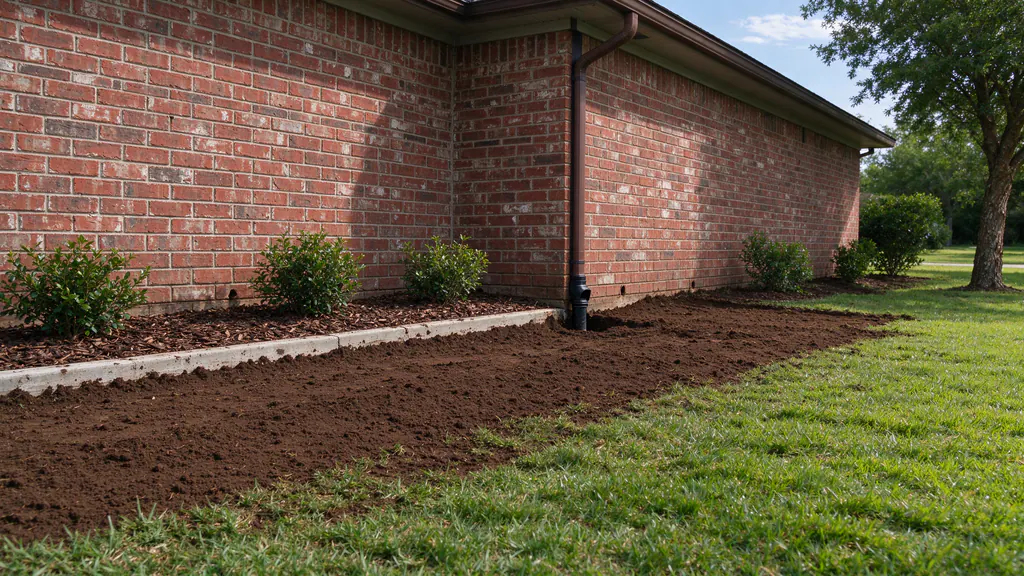
Las Colinas clay shows a linear extensibility near 17 percent in the USDA soil survey, a high shrink-swell rating. Drainage helps by stopping roof and surface water from collecting at one wall. Deep drains close to a slab can also dry one side, so depth and distance from the house are design decisions, not guesses. If cracks are already showing, a foundation engineer's view comes first. Watering the soil evenly in long dry spells is part of the same balance. Clay, water and slabs
Standing water in a crawlspace usually comes from surface water running in at low vents or soil sloping toward the house, and sometimes from a plumbing leak. The order of fixes is the same: rule out leaks, fix grade and roof water outside, then add a crawlspace drain to a sump only if water still collects. Ventilation helps the soil dry after the water stops arriving. A sump under the house needs a discharge line to an allowed outlet. Then the crawlspace is checked again after the next heavy rain. Crawlspace water
When a yard or crawlspace sits lower than every outlet around it, gravity cannot move the water. An exterior sump collects it in a buried basin and pumps it up and out to a point that can take it, which is common on flat lots near the Trinity and creek bottoms.
Pumped drainage is the last choice, not the first, because it needs power, a working float and occasional cleaning. When a gravity outlet exists, even a long one, it usually costs less over the life of the system.
We size the basin and pump from the area that drains to it, add a check valve so water does not flow back, and show you how to test the float. A sump on a flat lot near the Trinity bottoms often replaces a gravity outlet that simply does not exist.
Where a gravity outlet does exist but is far away, we price both options so you can compare the long pipe against the pump.
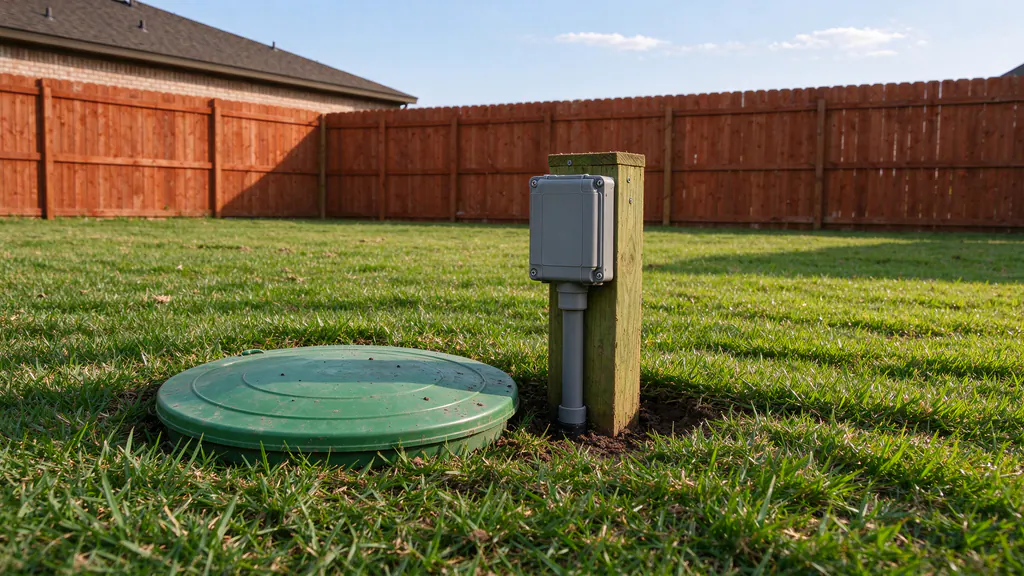
A sump moves water fast, so its outlet matters more than a gravity drain's. Dumping it on the lawn just recirculates it, and pointing it at a neighbor can be unlawful under Texas Water Code 11.086. Common choices are a pipe to the curb where the city allows a curb core, a swale toward the street, or a dispersal area well away from the house. Long discharge lines are buried in solid pipe so they do not freeze or get cut by a mower. Sump discharge options
A drain that used to work and now does not has a reason: a crushed or bellied pipe, roots, silt packed into the stone, a buried outlet, or a design that never had enough fall. Repair starts by finding which one, with a flow test and, where it helps, a camera.
When the line is sound and the problem is local: clear it, replace a crushed section, reopen the outlet.
When the concept was wrong: no outlet, no fall, or fabric and stone clogged with clay along the whole run.
Jetting clears silt and roots from smooth solid pipe, and a camera shows where a line has sagged or crushed. Neither fixes a perforated line wrapped in clogged fabric, which has to be dug up and rebuilt. We expose only what the diagnosis points to, so a repair does not become a full replacement by accident.
Many older systems around Irving were built with thin corrugated pipe in a fabric sock. When those fail, the fix is usually a rebuild with fabric around the stone and smooth pipe inside it.
You receive a written note of what failed, what was replaced and how the line was tested.
Small repairs are often finished in a day.
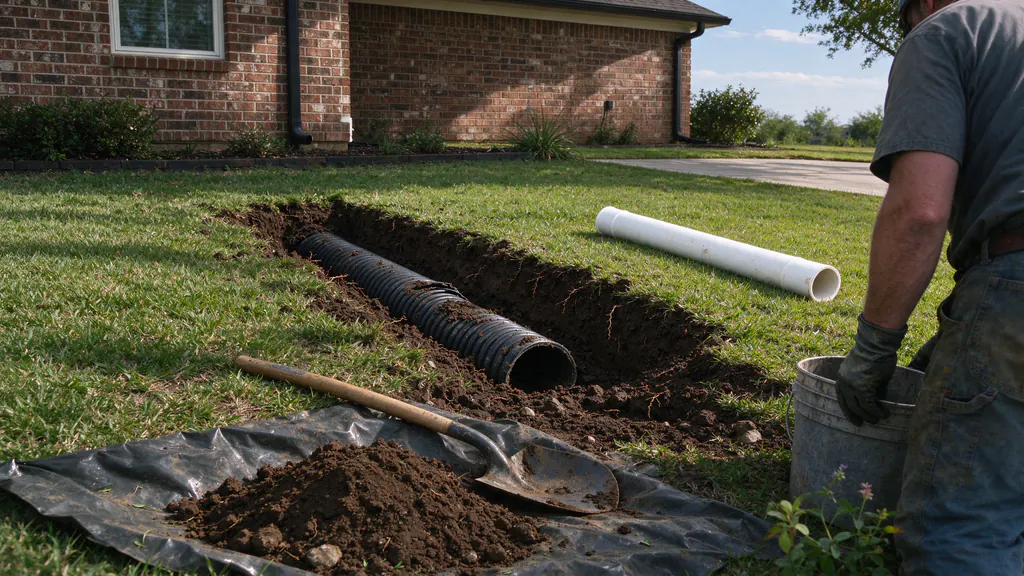
There is no fixed lifespan. A drain with the right fabric, clean stone, smooth pipe and a free outlet can work for decades; one built with sock pipe in raw clay can silt up within a few years. Slower draining after storms, wet ground over the line and a dry outlet are the signs to look for. Cleanouts let a line be flushed before small problems become a replacement. Roots near trees are a common cause of a slow line. French drain lifespan
Parking lots, loading areas, HOA common areas and small commercial lots have the same physics as a yard at a larger scale, with more paving and more people affected when water stands. We handle trench drains across drives and docks, inlet and pipe repairs, regrading of landscaped areas and erosion at outfalls.
Larger systems such as detention ponds and engineered stormwater designs need a civil engineer's plan and the city's review. We work from those plans; we do not replace them. Access, phasing around business hours and keeping drives open are part of the estimate from the start.
Trench drains at loading docks and drive entrances, clearing and repairing parking-lot inlets and their pipe, regrading turf and landscape islands, and stopping erosion where storm pipes discharge into a swale or channel.
Site plans or civil drawings if they exist, the hours the lot has to stay open, and any HOA or property-management approvals.
We provide a written scope, a work schedule that keeps drives and entrances usable, and photos of what was done for the property file.
Erosion at outfalls is handled with rock aprons or turf reinforcement sized to how fast the water leaves the pipe.
Lots stay open during the work wherever the layout allows.
Standing water is a symptom with several possible causes, and the fix depends on which one you have. In central Irving, rain soaks through sandy topsoil and stops on the clay a foot down, so the lawn stays soft for days. In Las Colinas the clay starts at the surface and water simply sits. A leaking sprinkler valve or a neighbor's irrigation can do the same with no rain at all.
Puddles on clay or in low spots usually call for regrading, a catch basin or both.
Ground that stays soft for days after rain usually calls for a shallow French drain along the clay line.
The site visit sorts out which applies. Often the answer is a mix: regrade the low corner, bury the downspout that feeds it, and add a basin or a short drain only where water still collects. That order keeps the job no larger than it needs to be.
A short note of what we found comes with the estimate.
Standard homeowners policies cover sudden water damage inside the house but exclude flood, and they generally do not pay to fix how a yard drains. Flood coverage is a separate policy, usually with a 30-day wait. Drainage work is a maintenance cost, which is why it is worth fixing before water reaches the house. Some policies cover water backing up through drains as an add-on, so it is worth reading your declarations page. Lenders require flood insurance for homes in a designated flood zone. What insurance covers
Every drain ends somewhere, and in Dallas County that somewhere is governed by state law and city rules. We settle the outlet before we price the trench.
A French drain or downspout line can end at a curb core through the street curb, at an alley, in a grassed swale, at a pop-up emitter in the lawn, or at a pump. University Park requires roof drainage to be piped through the curb or to the alley line, and Coppell permits curb cores for yard drains as engineering work. The best outlet is the lowest point the water can legally reach. An outlet that ends inside the fence line just moves the puddle. Where a French drain drains
Rules vary by city. Dallas exempts single-family lots under two acres from its grading permit, but floodplain lots are reviewed. Grand Prairie requires an earthwork permit when a lot's grade or drainage pattern changes. Work in the street right-of-way, like a curb core, usually needs city approval. For Irving, we confirm the requirement for each address before work starts. New homes and additions in Southlake also need an engineered drainage plan. Floodplain fill needs review in every city we serve. Drainage permits
Texas Water Code section 11.086 makes it unlawful to divert or impound surface water in a way that damages another property. That cuts both ways: you cannot aim a drain at a neighbor, and a neighbor's regrading should not flood you. Fort Worth's stormwater office treats lot-to-lot problems as private matters it can only help mediate. Grand Prairie bars concentrating runoff onto an adjacent lot without an easement or a recorded release. Talking to the neighbor first resolves most of these. Neighbor runoff in Texas
A drain fails when it is built in the wrong place or has nowhere to send the water. Starting from the source avoids both.
We trace the water to its source and dig a test hole where it matters, because Irving soils change within a mile.
Typical ranges and what moves them are published, and the cost tool gives a number without a phone call.
Restoration is in the estimate: sod, sprinkler lines and any concrete that had to be cut.
Fixing yard drainage starts with three questions: where does the water come from, how does it move through your soil, and where can it legally go. A puddle on Ferris clay in Las Colinas needs surface capture; a soggy lawn on central Irving's sand over clay needs a shallow interceptor; a wet lot near the Trinity may need a pump because every outlet is higher. Irving averages 37 inches of rain a year, but it is the hour-long bursts that overwhelm a yard. The full yard drainage guide
Four stages, the same for a single downspout line or a whole-yard system.
You describe what you see and send photos if you have them. We ask about the lot, the street and any past work.
Elevations, the water's source, soil in a test hole, the outlet options and the rules for your address.
A utility locate first, then trenching, pipe, stone, basins or grading, laid to the planned fall.
A water test from the far end, then backfill, sod and sprinkler repairs.
Before any digging, the contractor files an 811 locate request, and the marks appear as paint and flags in the yard a few days before work. A single French drain or downspout line is often cut, laid and backfilled in a day or two. The trench line is visible until the new sod knits in, sprinkler lines crossed by the trench are repaired, and spoil that cannot go back in the trench is hauled away. Before backfill, the line is tested with water from the far end. Install day, step by step
A photo and your address are enough to start.
Typical ranges and what each one covers. Your site visit turns a range into a written number.
Covers trench, fabric, stone, perforated pipe and a basic outlet. Depth, outlet distance, roots, hardscape and sod restoration push a job toward the high end; the outlet decision matters more than the footage. A short side-yard run to a pop-up emitter is the low end; a long, deep line to the curb with a curb core and concrete to cut is the high end. Published figures are typical ranges, not quotes. French drain cost in Irving
Includes the basin, grate and solid pipe to an outlet. Most of the cost is the trench to the outlet, not the box; a second basin on the same line costs much less than the first. Basins in a patio cost more than basins in turf because concrete has to be cut and replaced. Grate material and the outlet distance move the rest. Grates rated for car traffic cost more than turf grates. A second basin on an existing line is mostly the cost of the box and a short branch. Catch basin cost
For a straightforward run to a pop-up emitter. Long runs to the curb, a curb core, crossing a driveway or a walk, and larger pipe for big roof sections cost more. Several downspouts sharing one trench to the same outlet bring the cost per downspout down. A curb core may add a city fee where one is required. Pop-up emitters are the least expensive outlet where the lawn slopes away from the house; flat lots usually need a longer run. Prices here are national budgeting figures, not quotes. Downspout drainage cost
Most drainage bills come down to linear feet of trench, how deep it runs, how far the outlet is, what has to be cut and replaced (concrete, sod, sprinkler lines), soil haul-off, and any permit or curb-core fee. Two yards with the same puddle can differ by thousands because one has an outlet ten feet away and the other needs a pump. Ranges on this page are typical figures, not quotes; a written estimate follows the site visit. The cost tool shows the effect of each choice. Drainage cost in Irving · Try the cost tool
Most yards come down to one of these decisions. Here is how they differ.
The question is whether water sits on top of the ground or moves through it. A puddle on clay is a surface problem, so a basin or regrading wins. Ground that stays soft for days is a subsurface problem, so a French drain wins. Many Irving yards need both on one line. A basin can also feed into the same solid pipe that carries a French drain's water to the outlet. When in doubt, a test hole shows which one you have. French drain vs catch basin
The names sound alike but the jobs differ. A trench (channel) drain is a grated trough in concrete that catches surface water crossing a driveway or patio. A French drain is buried stone and pipe that collects water in the soil. Paving gets a trench drain; lawns get a French drain or a basin. Some driveways need both: a trench drain at the garage and a French drain in the side yard. Load rating matters for trench drains under cars. French drain vs trench drain
A dry well is a buried chamber that lets water soak into the ground. That depends on soil that absorbs water, and most Irving clay is in the slowest drainage group in the soil survey. In clay, a dry well fills with the first storm and stays full. A piped outlet or a pump is usually the honest answer. The exception is a lot with sandy soil to depth, which a test hole confirms. Even then, an overflow route is needed. Dry wells in clay
Water from a creek or the Trinity rising onto a property is a floodplain issue, and no yard drain can stop it. Water that collects from rain on your own lot and your neighbors' is a drainage issue, which grading and drains can fix. Dallas lets owners check flood zones through the county appraisal district's FEMA layer. Many yards have both, and the fix only addresses the drainage part. A survey or elevation certificate settles which applies. We check the FEMA map before designing. Floodplain or drainage?
Irving and a 30-mile radius. Each area below has its own soils and rules, and its page explains them.
No grading permit for house lots under two acres; floodplain lots reviewed. Blackland clay east, chalk in Oak Cliff.
Lot-to-lot drainage prohibited; an earthwork permit when grade changes. Trinity floodplain clay in the north.
Curb cores for yard drains are permitted city work. Flat Burleson clay.
Roof water must be piped to the curb or alley; side-yard grades capped at 5 percent.
Engineered drainage plans for new homes and additions. Sandy loam over clay.
Also serving Las Colinas, Valley Ranch, Farmers Branch, Grapevine, Garland, Addison, Flower Mound, Euless, Hurst, Bedford and east Fort Worth. All service areas
Short answers here; each links to a full guide.
Only if the water is moving through the soil. Water sitting on top of clay needs a catch basin or regrading first.
Often, through a curb core, but it usually needs city approval. University Park requires it for roof water; we confirm the rule for each address.
A strip about the width of the trench plus the spoil area. Sod is re-laid and sprinkler lines repaired.
Usually 12 to 24 inches for yard work, set by the fall needed to reach the outlet rather than a fixed depth.
Yes. A locate request goes in before any trench, and marks show up as paint and flags a few days before work.
It removes one cause, uneven wetting along one side. It is not foundation repair, and existing movement needs an engineer's assessment.
A leaking sprinkler valve or line, a neighbor's irrigation, or groundwater. We check those before designing a drain.
It is better not to. Roof water in a burst storm floods the drain's stone; keep roof water in its own solid line.
A single line is often a day or two after the locate. Whole-yard systems take longer and can be phased.
Yes: trench drains, inlets, pipe repairs and regrading. Engineered stormwater systems follow a civil engineer's plan.
Request an estimate or call.