Water that stands for a day after rain, or ground that stays soft for a week, has a cause you can usually find from the yard itself. The cause decides the fix.
A puddle that vanishes an hour after a storm is normal. A puddle that is still there the next morning, or a lawn that squishes underfoot for a week, means water is reaching that spot faster than it can leave. Rein Irving Drainage Company starts with the cause rather than the symptom, because the right fix for standing water depends entirely on where the water comes from and how it moves through your soil.
Read the yard before choosing a fix
Two yards with the same puddle can need completely different fixes. A few questions sort most of them out:
Is the water on top or in the ground? A puddle sitting on hard clay is surface water. Soft, soggy ground with no puddle is water in the soil.
Where does it come from? Watch during a storm. Does water arrive from a downspout, from across the lawn, from a neighbor’s side or from the street?
Is it wet with no rain? Then it is probably a leak, not drainage.
Does the spot have a way out? Is there any lower ground, curb or alley it could reach?
Irving has two broad kinds of ground, and both hold water, in different ways.
In Las Colinas and much of north Irving, the USDA soil survey maps Ferris and Heiden clay at the surface: about half clay particles, absorbing water extremely slowly. Rain on that ground runs across the surface and stops at the first low spot. That is surface water, and grading and catch basins are the tools.
In much of central Irving the survey shows sandy soil over clay: about 15 inches of loamy fine sand over sandy clay loam near Irving Boulevard, and about 8 inches of sandy loam over clay in Plymouth Park. Rain soaks through the sand and stops on the clay, so the lawn stays soft for days even with no visible puddle. That is perched water, and a shallow French drain along the top of the clay is often the fix.
The soil survey describes sample points, not every lot, so a test hole a couple of feet deep tells you which you have. The French drain versus catch basin guide shows how to read it.
Storms, not averages
The DFW area averages about 37 inches of rain a year, but yards flood in bursts. NOAA’s Atlas 14 puts Irving’s 2-year storm at 1.77 inches in one hour. A yard that copes with an all-day drizzle can still hold water for a day after a one-hour burst, which is why a fix is sized for the burst.
Water from next door
When the water clearly comes from a neighbor’s lot, the fix on your side is usually an interceptor drain or swale along the line, sending the water to your outlet. Texas Water Code section 11.086 makes it unlawful to divert surface water in a way that damages another property, which applies to both of you. The guide to neighbor water runoff in Texas explains what the law covers and how these conversations usually go.
Before you call anyone
Check the water meter with everything off to rule out a leak.
Extend downspouts away from the house with temporary extensions.
Pull mulch and soil back so beds do not hold water at the slab.
Clear grates, emitters and outlets of grass, leaves and mulch.
Take photos during a storm and the next day. They are the best evidence of where water comes from.
Standard homeowners policies generally exclude flood and do not pay to change how a yard drains, so drainage is usually a maintenance cost. Water rising from a creek or the Trinity is a floodplain matter that no yard drain can stop. See does insurance cover yard flooding.
How we approach it
Rein Irving Drainage Company plans and manages each job; installation is carried out by licensed and insured drainage contractors we work with. The plan starts with the source and the soil, then the outlet, then the fix. Where there is more than one source, it becomes a whole-yard drainage plan so the lawn is dug once.
Cost
The fix decides the cost. As a guide, a standard French drain runs about $25 to $55 per foot installed in the Dallas area; as national budgeting ranges, catch basins run about $500 to $1,500 each and buried downspouts about $150 to $350 each. The drainage cost guide and the cost tool help set a budget.
What this work looks like
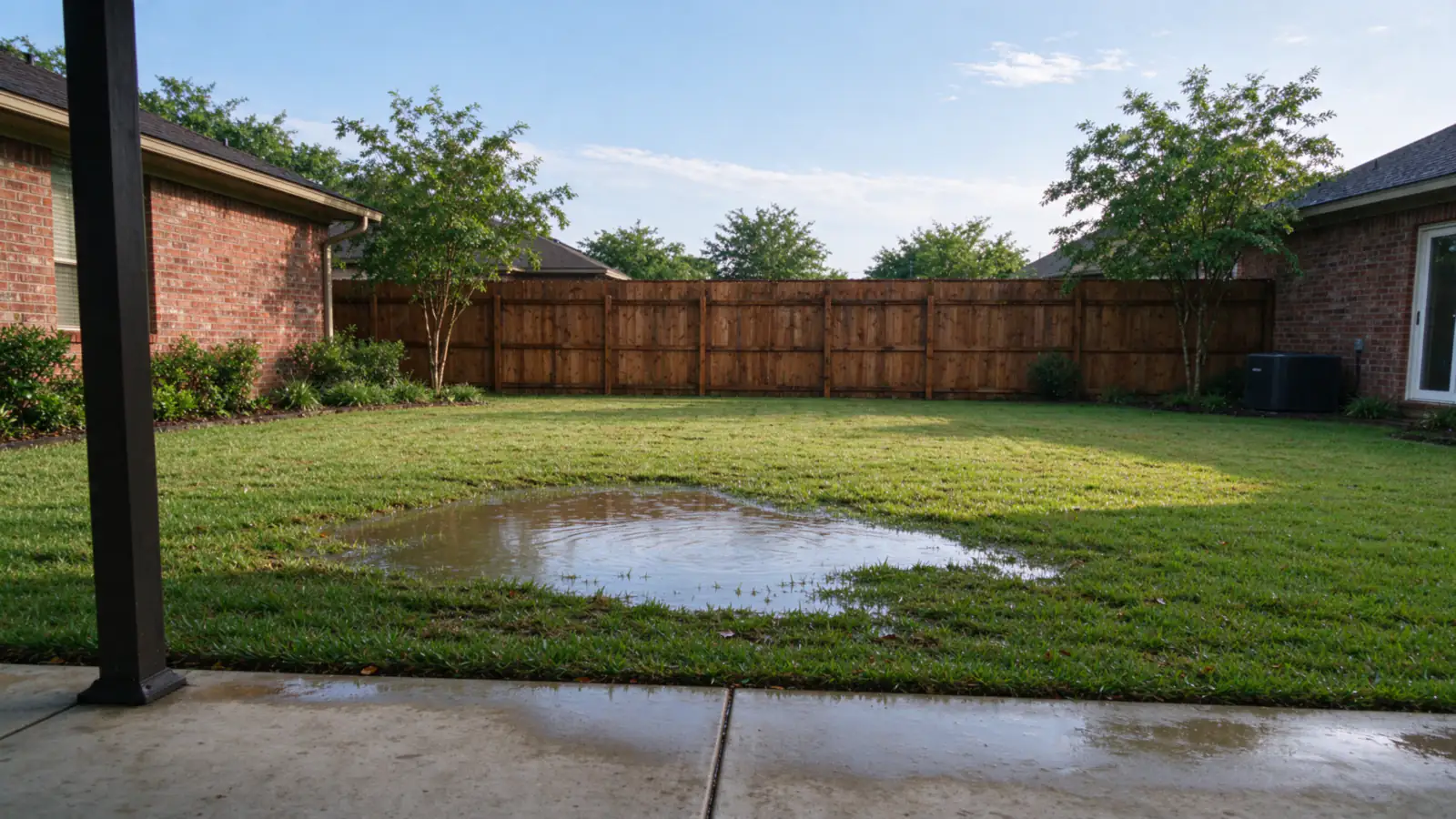
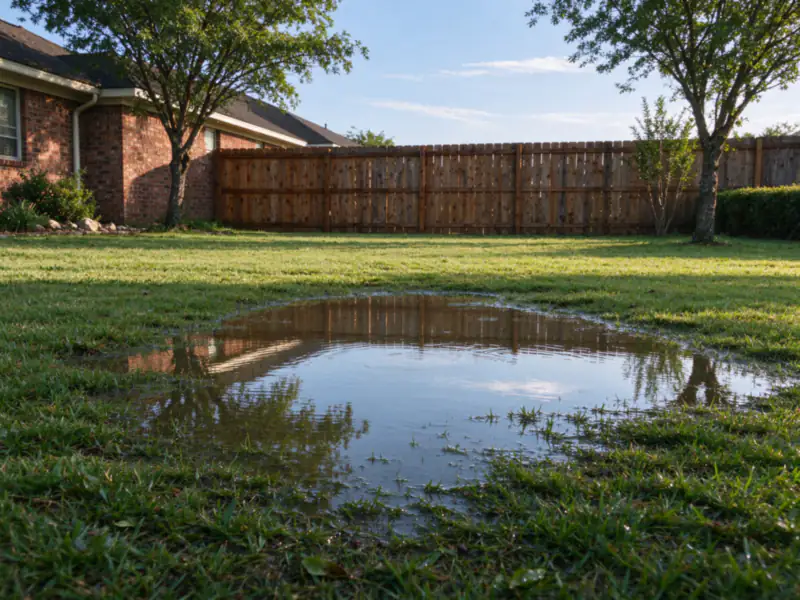
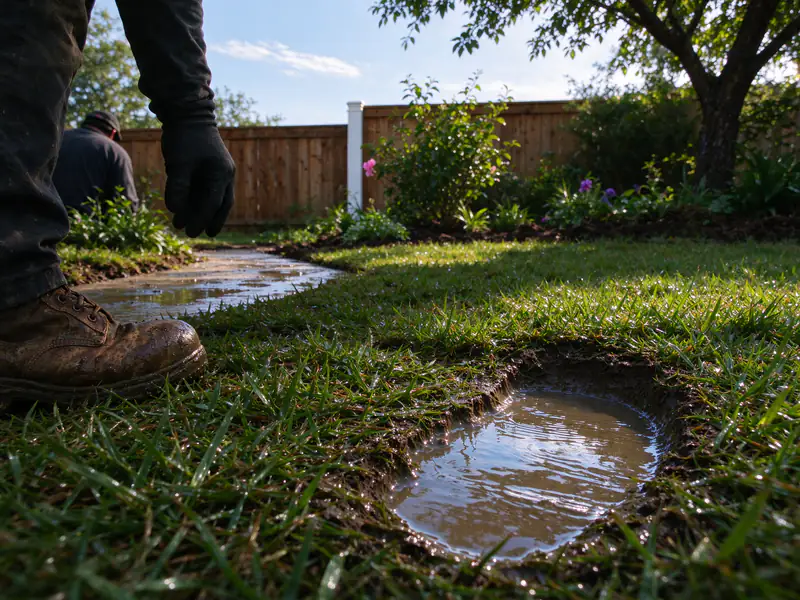
Wide puddle standing in a flat backyard lawn on a sunny morning after rainSoggy lawn turf with water filling a boot print
Questions people ask
How long is too long for water to stand in a yard?
A few hours after a heavy storm is normal. Water still standing the next day, or ground that stays soft for several days, means water is not leaving the lot fast enough and has a cause worth finding.
Can standing water hurt my foundation?
Water that stands against or near a slab on expansive clay keeps that side of the soil wetter than the rest, which is a common cause of uneven movement. Water in the middle of a lawn far from the house is mostly a lawn and mosquito problem.
Why is my yard wet when it has not rained?
Usually a leaking sprinkler valve or line, a neighbor's irrigation, or a plumbing leak. With every fixture and the sprinklers off, a moving water meter dial points to a leak on your side of the meter.
Will aerating the lawn fix standing water?
On sandy topsoil with a compacted surface, aeration helps water soak in. On dense clay, or where water perches on clay a few inches down, it does little, because the problem is below the depth an aerator reaches.
Does standing water attract mosquitoes?
Water that stands for several days can breed mosquitoes. Fixing the drainage removes the water; until then, emptying containers and keeping drains and basins clear reduces breeding spots.
Water standing in the same place every storm?
Send a photo during or right after rain, and one from the next day.