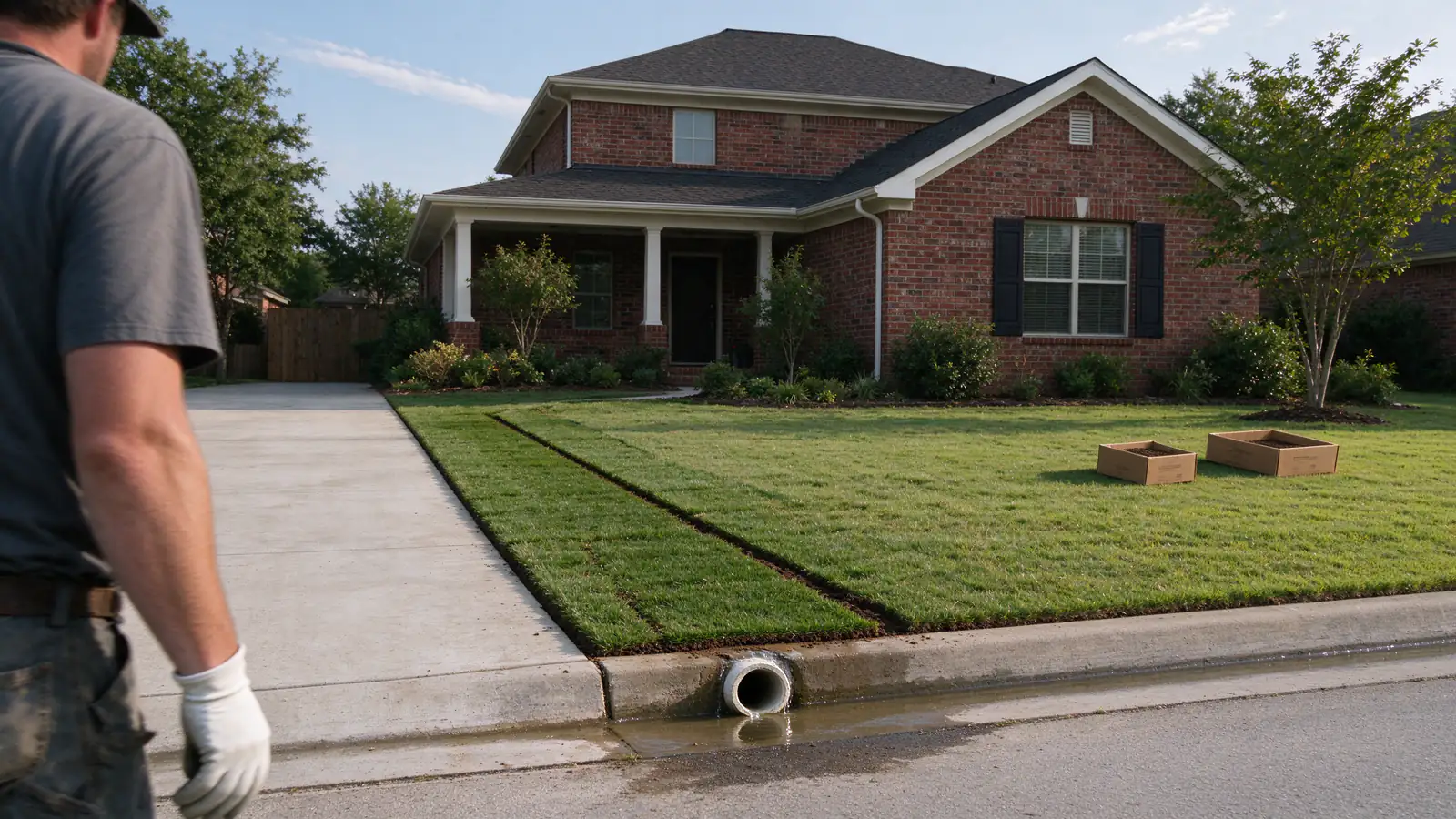
Rein Irving Drainage Company works in Coppell, just north of Irving’s Valley Ranch, where two things shape almost every drainage job: the ground is flat, and it is heavy clay. Water that falls on a Coppell lot mostly stays on the surface until it finds a low spot, so the work is about catching it there and carrying it to the street. Coppell has also made the outlet side clearer than most cities by permitting curb cores for yard drains. This page covers both, and what they mean for catch basins, buried downspouts and regrading.
Flat Burleson clay
At the USDA soil survey sample point in Coppell, the soil maps as Burleson clay on 0 to 1 percent slopes. It is about 50 percent clay particles, with a plasticity index of 41 and a very low saturated conductivity of about 0.21 micrometers per second, and it falls in hydrologic group D, the slowest-draining class.
Put plainly: rain does not soak in, and the ground does not slope enough to carry it off by itself. Puddles form in every slight dip and stay there. The clay also swells when wet and shrinks when dry, so water collecting at one side of a slab matters for the house as well as the lawn.
A sample point describes one spot, not every lot. A test hole a couple of feet deep shows what is under your own yard.
Surface capture first
On ground like this, the order of fixes matters.
- Roof water goes into buried downspout lines so it never lands on the clay at the slab.
- Low spots get catch basins set slightly below the lawn so surface water drops straight into pipe.
- Grade is restored so the ground falls toward each basin and away from the house; on 0 to 1 percent slopes this needs careful elevations.
- French drains come in only where the ground stays soft below the surface. On dense clay a buried trench under a puddle collects little, because the water cannot get down to it. The French drain versus catch basin guide explains the difference.
Curb cores are permitted work
The hardest part of drainage on a flat lot is the outlet. In Coppell, the most direct outlet is often the street curb. The city issued a residential “Curb Core for Yard Drains” as a construction and development permit in 2022, with a $100 fee, and its master fee schedule prices engineering inspection of drainage improvements at $1.20 to $1.50 per linear foot.
That tells a homeowner two useful things. A pipe through the curb is a recognized, permitted way to get yard water to the street. And it is engineering work the city reviews, not something to cut in on a weekend. We confirm the permit and inspection requirements for each address before work starts. The permits guide compares Coppell with Irving and the nearby cities, and where a French drain can drain covers the other outlet options.
Fall on a flat lot
With little natural slope, the pipe does the work the ground cannot. Smooth solid pipe holds steady fall over long runs, which matters when a basin in the back yard has to reach the front curb. Basin depth is set by the curb’s elevation: too deep and the pipe cannot reach the curb with fall; too shallow and the basin sits above the water it is meant to catch. Elevations shot from each low spot to the curb settle that before anything is dug.
Common Coppell jobs
- Back yard puddles with no alley. Catch basins in the low spots, solid pipe along the side yard and a permitted curb core at the street.
- Downspouts dumping at the slab. Buried lines sharing the same pipe to the curb.
- Side yards between houses. Narrow, flat strips that collect water from two roofs; a shallow swale or a line of small basins.
- Patios poured toward the house. A channel drain at the low edge.
What Coppell drainage work costs
As national budgeting ranges, catch basins run about $500 to $1,500 each and buried downspouts about $150 to $350 each; a typical Dallas-area range for a standard exterior French drain is about $25 to $55 per foot installed. In Coppell, the curb core permit fee and per-foot engineering inspection fees are added where they apply. The length of pipe from the back yard to the curb is usually the biggest cost driver on a flat lot. See the catch basin cost guide or try the cost tool.
Rein Irving Drainage Company plans and manages each job; installation is carried out by licensed and insured drainage contractors we work with.
Nearby
We also work in Dallas, Grand Prairie with its lot-to-lot drainage rules, and Southlake. See all service areas.
Questions people ask
Can a yard drain go through the curb in Coppell?
Yes, with a permit. Coppell has issued a residential curb core for yard drains as a construction and development permit, with a $100 fee, so a pipe through the street curb is treated as permitted engineering work.
Why does water sit on my Coppell lawn instead of soaking in?
At the USDA soil survey sample point in Coppell, the ground is Burleson clay on 0 to 1 percent slopes: about half clay particles and very slow to absorb. Flat ground and dense clay together leave water on the surface.
Is a French drain a good idea in Coppell clay?
For surface puddles, usually not as the first step, because water on dense clay cannot reach a buried pipe quickly. Catch basins, buried downspouts and grading to a curb outlet do more. A French drain fits where ground stays soft below the surface.
Does Coppell inspect drainage work?
Coppell's fee schedule includes engineering inspection of drainage improvements, priced per linear foot, alongside the curb core permit. Which inspections apply to a given job is confirmed with the city before work starts.
How flat is too flat for a Coppell backyard?
A lawn needs steady fall to an outlet. On slopes of 0 to 1 percent, as at the Coppell soil sample point, there is little fall to work with, so grading has to be precise and pipe often has to carry water the last stretch to the curb.