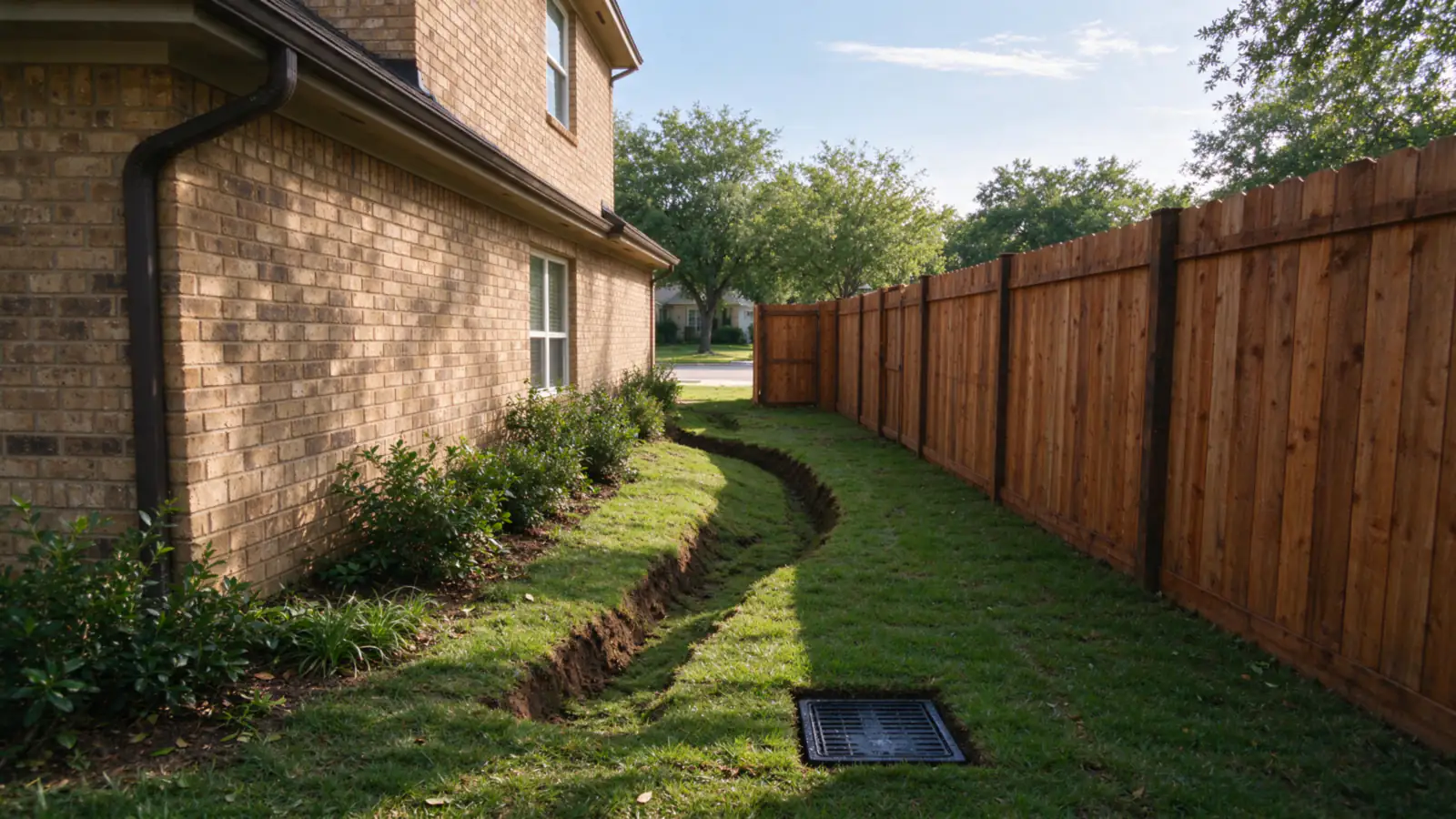
Rein Irving Drainage Company works across Dallas from Irving, and Dallas is one of the places where two neighboring yards can need completely different drainage. The city’s rules change depending on whether a lot is in a floodplain, and the ground changes from deep black clay to a thin layer of clay over hard ground across a few miles. This page explains both, and what they mean for a French drain, regrading or a catch basin on a Dallas lot.
The grading permit most Dallas homeowners do not need
The City of Dallas requires a paving and grading permit for that kind of work, but its checklist exempts lots under two acres that hold a single-family or duplex use. For most Dallas houses, that means regrading a backyard, building a swale or reshaping a side yard does not need a grading permit of its own.
That exemption does not cover everything. Tree removal has its own permit through the city arborist. Anything in the street right-of-way, such as a curb core for a drain outlet, needs city approval. And floodplain lots follow a different process, below. The drainage permits guide compares Dallas with Irving and the nearby cities.
Floodplain lots are reviewed first
Dallas is drained by the Trinity River and its tributaries, including White Rock Creek, with a drainage area of 139 square miles, and Fivemile Creek, with 55 square miles. Residential and commercial development within the regulatory 1% annual chance floodplain, including earthwork, is reviewed by the city before construction is permitted. The Drainage Design Manual also sets fill permits and separate rules for defined sump areas near the levees.
For drainage work, that means:
- Regrading that adds soil on a floodplain lot needs the city’s review before it starts.
- Drains that do not change ground levels, such as a buried downspout line or a catch basin set flush with the lawn, are usually simpler, though the outlet still has to be allowed.
- Creek flooding is not a drainage problem. Water rising from a creek cannot be stopped by a yard drain. The city’s Floodplain Management section, at 214-671-2219, makes site visits for flooding, drainage and erosion problems.
You can check whether a lot is in the 1% annual chance floodplain through the Dallas County appraisal district’s FEMA flood-zone layer or the city’s zoning map. Our guide on floodplain versus lot drainage explains how to tell the two apart.
Three kinds of Dallas ground
The USDA soil survey shows how much Dallas soils change across the city, and each changes the drainage plan.
These describe one sample point in each area, not every lot, so a test hole comes before any design. On Houston Black clay, the drains that work best are usually catch basins and buried downspouts that take water away before it reaches the soil, plus grading that keeps water off the slab. Where a hard layer sits close to the surface, as at the Oak Cliff sample point, routing a drain around it can cost less than cutting through it.
Where Dallas drains can empty
Every drain needs an outlet the water is allowed to reach. On Dallas lots, the usual choices are the alley, a curb core through the street curb with city approval, a grassed swale along the property line toward the street, or a pop-up emitter in a lower part of the lawn. Where a lot backs onto an alley, the alley often gives a closer, lower outlet than the street.
Texas Water Code section 11.086 makes it unlawful to divert surface water in a way that damages another property, so a drain cannot be pointed at a neighbor’s yard. The full list of options is in where a French drain can drain.
What Dallas drainage work costs
A typical Dallas-area range for a standard exterior French drain is about $25 to $55 per foot installed. Catch basins run about $500 to $1,500 each and buried downspouts about $150 to $350 each as national budgeting ranges. In Dallas, the main things that push a job up are hard layers near the surface that slow trenching, long runs to the street on deep lots, concrete to cut on older driveways, and floodplain review where grades change. The cost tool gives a range for your own job.
Common Dallas jobs
- Pier-and-beam houses with water underneath. Where a house is raised on piers, the order of fixes is to rule out a plumbing leak, fix grade and roof water outside, then add a crawlspace drain and sump only if water still collects. See water under a pier-and-beam house.
- Infill houses built higher than the neighbors. A new house on a raised pad can send water toward older lots next door. Dallas’s own infill guidance asks for grading that directs water away from the structure and toward the street, alley or a property-line swale.
- Black clay yards that pond in spring. Surface water on Houston Black clay calls for basins and grading before any French drain.
We also work in nearby University Park, where roof drainage has to be piped to the curb or alley, and in Grand Prairie and Coppell, each with its own rules.
Questions people ask
Do I need a grading permit to regrade my yard in Dallas?
Dallas's paving and grading permit checklist exempts lots under two acres that hold a single-family or duplex use. Work in a floodplain, tree removal and anything in the street right-of-way follow their own rules.
My Dallas lot is in a floodplain. Can I still add drainage?
Yes, but earthwork and fill inside the 1% annual chance floodplain are reviewed by the city before construction, so grading that adds soil needs that review first. Drains that do not change ground levels are simpler.
Why does my yard in east Dallas crack in summer and pond in spring?
Much of east and north Dallas maps as Houston Black clay, which is more than half clay particles and swells when wet and shrinks when dry. Water sits on it in wet months and it opens wide cracks in dry ones.
What does a French drain cost in Dallas?
A typical Dallas-area range for a standard exterior French drain is about $25 to $55 per foot installed. Depth, outlet distance and restoration move a job within that range.
Who can I call in Dallas about flooding from a creek?
The City of Dallas Floodplain Management section, at 214-671-2219, makes site visits for flooding, drainage and erosion problems. Creek flooding is a floodplain issue that yard drains cannot fix.