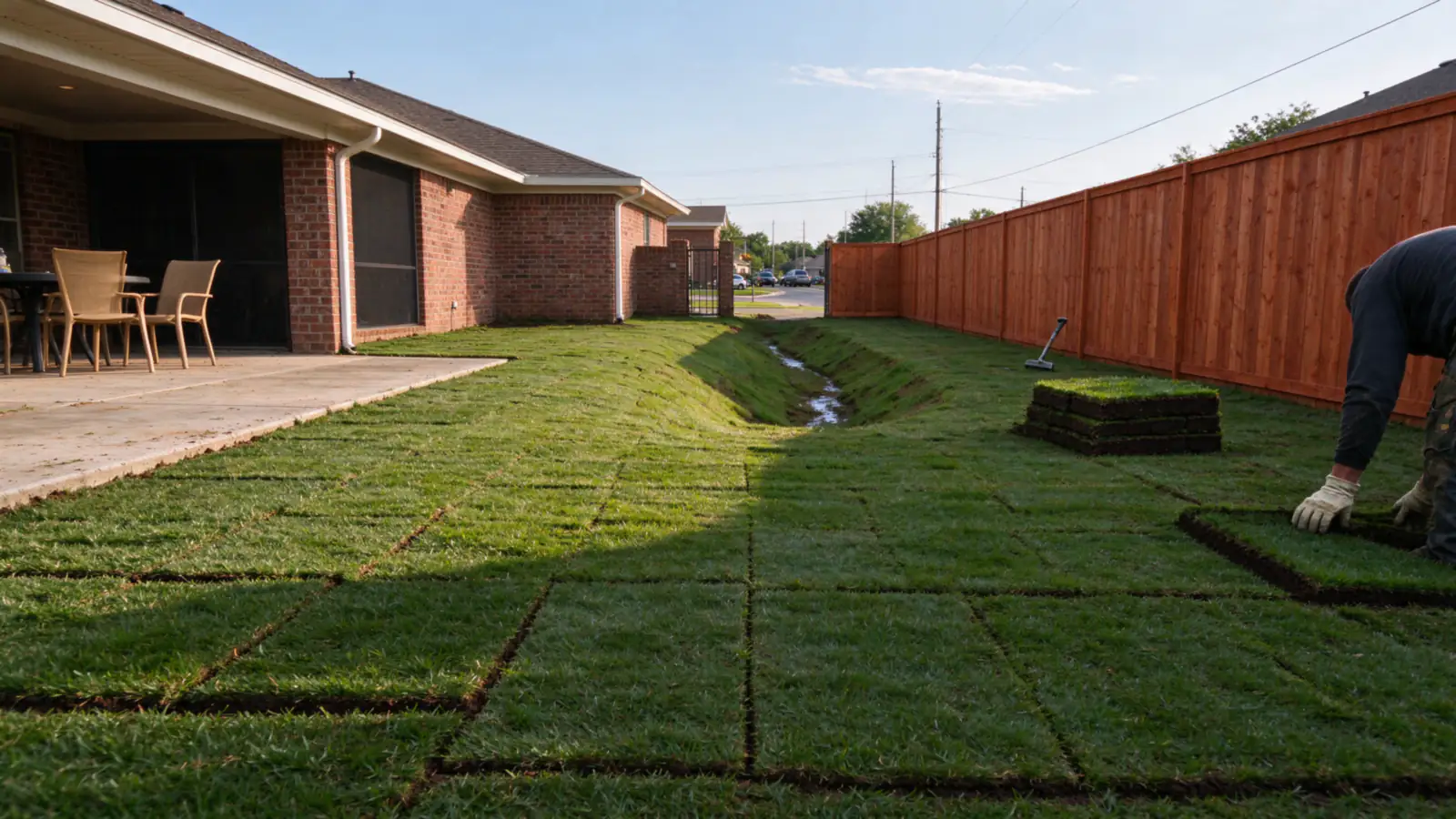
Rein Irving Drainage Company works in Grand Prairie, just southwest of Irving, and it is one of the clearest cities in the area to plan drainage for. Its development code and drainage design manual spell out where collected water may go, how steep a yard must be, and when reshaping a lot needs a permit. Those rules shape every French drain, catch basin and regrading job on a Grand Prairie lot, so this page starts with them.
Collected water cannot go to the neighbor
Grand Prairie’s Unified Development Code, Article 14, says stormwater that is collected or concentrated on a lot may not drain onto adjacent property except into a creek, channel, swale or storm sewer, unless there is an easement or a recorded release. The city’s drainage design manual goes further: lot-to-lot surface drainage is prohibited except on estate-zoned lots.
That changes how a drain is designed. A pipe cannot simply end at the back fence, and a pop-up emitter cannot be set where its water runs straight onto the next lot. Every collected line needs to reach the street, an alley, a channel or a swale that carries water along the property line to one of those. Statewide, Texas Water Code section 11.086 makes damaging diversion of surface water unlawful as well. The guide to neighbor water runoff in Texas explains how the state rule and city rules fit together.
Minimum slopes
The same manual sets minimum grades: 1 percent for earthen surfaces and 0.5 percent for paved ones. For a yard, 1 percent means a foot of fall over 100 feet, which sounds small but is often more than an older, settled lawn still has. Swales that have filled in, beds built up along a fence and sod laid over sod all flatten a yard below that line.
The slope guide shows how to measure your own yard with a string line and a level.
When regrading needs a permit
Grand Prairie’s Article 22 requires an earthwork permit for a residential lot when the plat calls for one, when the lot is over half an acre, or when the grade or drainage pattern is altered from the subdivision plan. The residential fee is $50 for lots under half an acre and $100 above that.
In practice, a job that only adds a buried downspout line or a catch basin set flush in the lawn usually leaves the drainage pattern alone. A job that reshapes the yard, moves a swale or changes which way water leaves the lot is the kind that triggers the permit. We sort that out before work starts. The permits guide compares Grand Prairie with Irving and the other nearby cities.
Trinity floodplain clay on the north side
The north side of Grand Prairie, toward the Trinity, sits on very different ground from the uplands to the south. At a USDA soil survey sample point there, the soil maps as Frio silty clay, frequently flooded, with a plasticity index of 34. It absorbs water slowly and swells and shrinks with moisture.
Two things follow for drainage. First, surface water on this clay is best caught at the surface, with grading and catch basins, before it has a chance to soak in. Second, outlets near the river can sit higher than the yard, especially when the channel is running high. Where no gravity outlet exists, an exterior sump lifts water to one.
A sample point describes one spot, not every lot, so a test hole comes before any design.
Floodplain or drainage?
Some Grand Prairie lots are close enough to the Trinity or a creek that the problem is not yard drainage at all. Water rising from a channel cannot be stopped by a drain in the yard, and grading in a mapped floodplain follows its own review. The guide to floodplain or drainage problems explains how to tell the two apart and where to look up a lot’s flood zone.
Common Grand Prairie jobs
- Water arriving from a higher lot. Because concentrated runoff may not cross lot lines, a neighbor’s water reaching your yard is often a conversation as much as a construction job. On your side, an interceptor drain or swale along the line carries it to your own outlet.
- Flat backyards with no fall. Lawns below the 1 percent minimum hold water in the middle. Regrading to restore fall, with a permit where the pattern changes, is often cheaper than pipe.
- Downspouts at the slab. Buried downspout drainage to the street or a swale moves roof water off expansive clay without crossing a lot line.
- Low lots near the river. Catch basins feeding a sump where gravity cannot reach an outlet.
What Grand Prairie drainage work costs
A typical Dallas-area range for a standard exterior French drain is about $25 to $55 per foot installed. As national budgeting ranges, catch basins run about $500 to $1,500 each and buried downspouts about $150 to $350 each. In Grand Prairie, the earthwork permit fee is $50 or $100 where it applies. Long runs to reach an allowed outlet and a pump on low ground are what push a job up most. The drainage cost guide and the cost tool help set a budget.
Rein Irving Drainage Company plans and manages each job; installation is carried out by licensed and insured drainage contractors we work with.
Nearby
We also work in Dallas, with its floodplain review and three kinds of ground, in Coppell on flat Burleson clay, and in Southlake. See all service areas.
Questions people ask
Can I drain my yard onto my neighbor's lot in Grand Prairie?
Not collected or concentrated water. Grand Prairie's development code says stormwater collected on a lot may not drain onto adjacent property except into a creek, channel, swale or storm sewer, unless an easement or recorded release exists.
Do I need a permit to regrade my yard in Grand Prairie?
An earthwork permit is required for a residential lot when the plat calls for one, when the lot is over half an acre, or when the grade or drainage pattern is changed from the subdivision plan. The residential fee is $50 under half an acre and $100 above.
How much slope does Grand Prairie require for yard drainage?
The city's drainage design manual sets minimum grades of 1 percent for earthen surfaces and 0.5 percent for paved surfaces, so water keeps moving toward an approved outlet.
Why does my north Grand Prairie yard drain so slowly?
On the Trinity side of the city, the soil survey maps Frio silty clay that is frequently flooded. It absorbs slowly, and outlets near the river can sit higher than the yard, which sometimes calls for a pump.
Which county is my Grand Prairie address in?
Grand Prairie spans parts of Dallas, Tarrant and Ellis counties. The city's own drainage rules apply across all of it, but floodplain maps and appraisal records are looked up by county.